About Financial Advice
About Financial Advice
Financial Planning Basics
What is Financial Planning?
Financial planning involves working with a professional to navigate through the complexities of investment, taxation and changing rules and regulations. By working together you can navigate a pathway to reach your specific goals, preferences and aspirations.
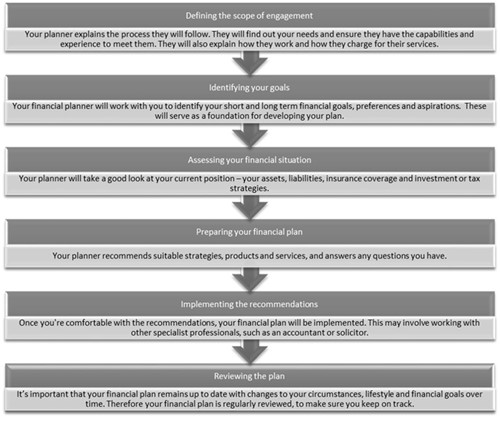
Financial planning can help you through all stages of your life. The financial planning process involves working closely with your financial planner across six key steps to build a plan tailored to you.
To gain the most value out of the financial planning process there are three fundamental issues that are important for you to consider and understand.
Goal Setting
The starting point for any plan is to set your personal goals. Financial goals are likely to be different for each person and need to reflect your specific preferences, aspirations and needs. Your goals may vary from short-term goals (less than one year) like buying a car, paying off your debt or going on a holiday, medium term goals (1-3 years) such as saving for your children’s education, or long-term goals (5 years or more) like saving for a comfortable retirement and leaving behind a legacy.
Your goals will be more real and achievable if you can apply the following attributes:
- Specific: Make them specific to you and your family.
- Measurable: Ensure there is a measurement in place to determine whether the goals have been met.
- Achievable: The goals need to be achievable so while you may set a stretched target, don’t set the target too high.
- Realistic: Your goals can be an aspiration but must still be grounded.
- Time-targeted: You need to set time targets to achieve your goals.
Budgeting
To put you on the path to building your wealth you need to start saving money. The best way to do this is to set yourself a budget. Setting a budget is important for everyone no matter your age or how much money you have. It is especially important for people who are struggling to meet their goals or who keep building up debt.
A budget is not about just cutting expenses. It is about finding a good balance between your income and your expenses and deciding what is important to you so that you have money left over to save.
There are two sides to a budget: Your income – includes income from all sources such as salary, interest, rental income and dividends, but only include your regular income and make sure you use after-tax income; Your expenses – includes mortgage repayments, bills and general living expenses.
Below are ten tips for setting a good budget: (1) Make it realistic or you will never stick to it; (2) Budget an amount for fun and personal expenses; (3) Save your pay rises, bonuses and tax refunds; (4) Look for small savings; (5) Pay by cash or EFTPOS to avoid credit card fees; (6) Reduce fees and charges; (7) Put your change into a savings jar; (8) Shop around and compare prices on insurance; (9) Use lay-by options instead of debt; (10) Update your budget each year.